Apple & Google: From "Thermonuclear War" to the Historic 2026 AI Partnership
In early 2026, the tech world was rocked by an official announcement: Apple would integrate Google’s Gemini AI model into the core of Siri. For younger users, this might seem like just another feature update. But for those who have followed the tech industry for over a decade, this is the most significant “pivot” in the history of Silicon Valley.
1. The 2010 “Thermonuclear” Declaration
To understand the magnitude of this 2026 partnership, we must travel back 16 years. In 2010, Steve Jobs—the soul of Apple—was reportedly furious when Google launched the Android operating system. He believed Google had betrayed Apple by “stealing” iPhone ideas, as Google’s then-CEO Eric Schmidt had previously sat on Apple’s board of directors.
In his biography, Jobs left behind a legendary quote:
“I will spend every penny of Apple’s $40 billion in the bank to right this wrong. I’m going to destroy Android because it’s a stolen product. I’m willing to go to thermonuclear war on this.”
The feud was so intense that Apple launched a “de-Googling” campaign on iOS. This peaked in 2012 with iOS 6, when Apple abruptly removed the default Google Maps and YouTube apps—staples of the iPhone since day one—to replace them with their own in-house products.
![IMAGE: Steve Jobs vs Android era illustration] —
2. A Decade of Rivalry and Billion-Dollar Lawsuits
Following that declaration of war was a decade of endless legal battles. Apple sued Samsung (Android’s biggest partner) in a high-profile patent war, eventually winning a $1 billion judgment.
For over 10 years, Apple and Google existed in a state of “coopetition”: While they competed fiercely in mobile OS markets, Google continued to pay Apple billions of dollars annually to remain the default search engine on Safari. However, in terms of core technology, they rarely allowed each other’s software to penetrate deep into their respective ecosystems—until now.
3. The 2026 Turning Point: Why Did Apple Choose Gemini?
What changed? Why did Apple finally agree to “borrow the brains” of the company Steve Jobs once vowed to destroy?
The answer lies in two words: Competitive Pressure.
The Generative AI revolution that exploded in late 2022 left Apple in a difficult position. Siri—once the pioneer of voice assistants in 2011—had become stagnant compared to the logic and creativity of OpenAI’s ChatGPT or Anthropic’s Claude.
Instead of spending another 3-5 years trying to build a Large Language Model (LLM) from scratch, Tim Cook—a far more pragmatic leader than Jobs—made a strategic gamble:
- For Apple: Integrating Gemini makes Siri smarter overnight, ensuring the iPhone remains the world’s premier “smart” device.
- For Google: Being present on over 2 billion iOS devices is an absolute victory over Microsoft and OpenAI in the battle for AI market share.
4. Tim Cook’s Pragmatism vs. Steve Jobs’ Passion
The 2026 partnership highlights the shift in Apple’s leadership philosophy. If Steve Jobs led Apple with emotion, perfectionism, and aesthetic vision, Tim Cook leads with efficiency and scale.
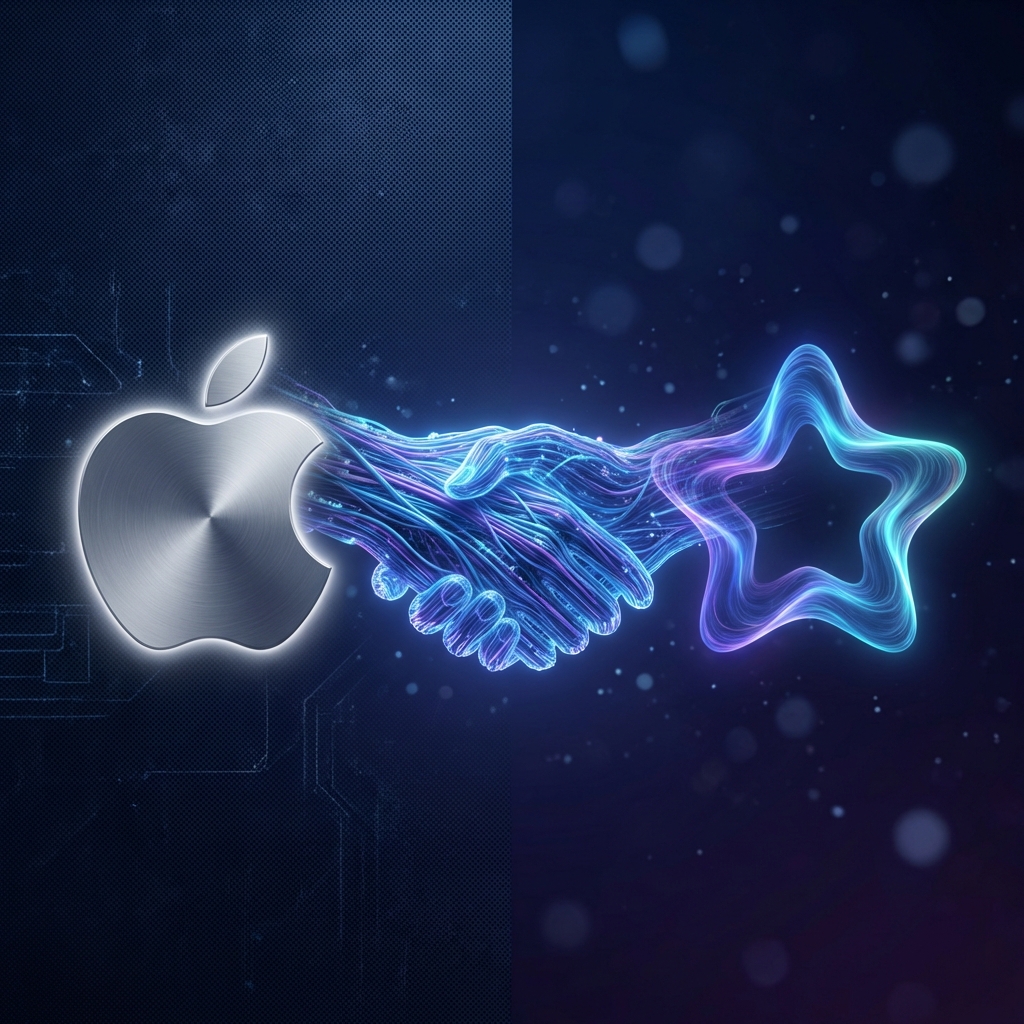
Bringing Gemini to Siri isn’t a surrender; it’s a brilliant business deal. Apple maintains control over the hardware, user privacy, and overall experience, while Google provides the “intelligence fuel.” It is the ultimate proof of the old adage:
“In business, there are no permanent enemies, only permanent interests.”
 —
—
5. What Does This Mean for You?
With Siri powered by Gemini, 2026 iPhone users can expect:
- Natural Conversations: No more “I found this on the web.” Siri can now engage in fluid, human-like dialogue.
- Complex Multitasking: Write emails, summarize long documents, or plan a week-long vacation with a single voice command.
- On-Device Speed + Cloud Power: The fusion of Apple’s silicon (On-device processing) and Gemini’s cloud scale provides lightning-fast responses.
Conclusion
The “Thermonuclear War” ignited by Steve Jobs has finally ended—not in ashes, but in a historic handshake. The presence of Google Gemini on the iPhone marks the end of a chapter of resentment and the beginning of a new era: The Era of Collaborative AI.
What do you think of this partnership? Is Apple becoming too dependent on Google, or is this a masterstroke by Tim Cook? Share your thoughts in the comments below!