Minecraft: The Ultimate Middle Game (And why you need to stop building your Dream Game)
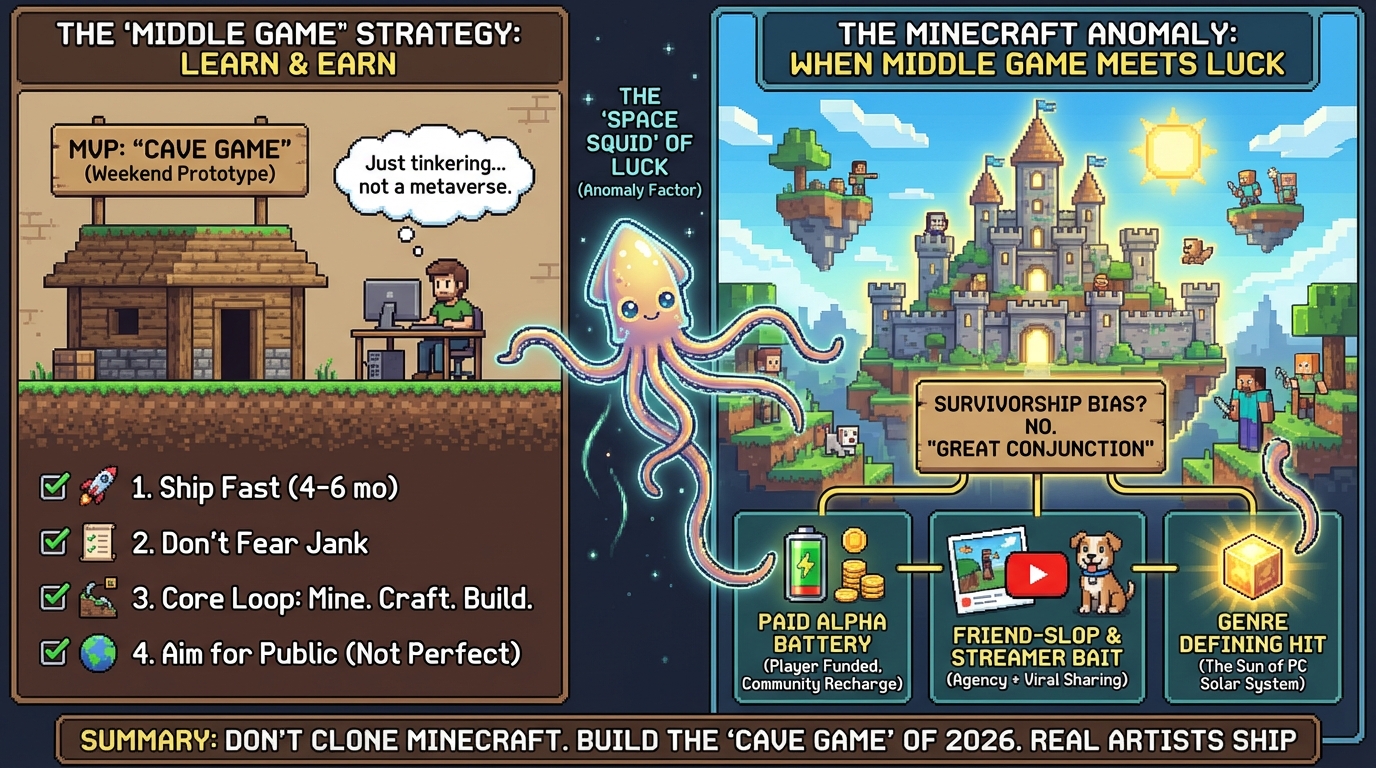
Middle games are the opposite of your dream game; they are games that you make quickly to learn the craft and earn rent money. The point of a middle game is not to become a millionaire but to get something public.
But sometimes, the “Space Squid” of luck intervenes, and a middle game becomes the sun of our solar system.
Today, I am deconstructing the biggest anomaly in video game history: Minecraft.
Now, I know, I know… say it with me: “SURVIVORSHIP BIAS!”.
I can hear the Reddit comments already: “Chris, you can’t learn from Minecraft, it’s a lottery ticket!”.
STOP IT.
Yes, there is luck involved. But if you look past the billions of dollars, Minecraft is actually the perfect example of the “Middle Game” strategy. It was an MVP (Minimum Viable Product) developed in a weekend. It fits the “Crafty-Buildy” meta-genre perfectly.
If you are early in your game dev journey, observe how Markus “Notch” Persson managed to ship fast, instead of spending years suffering for his art. .jpeg)
What is Minecraft (The 2009 Version)?
In May 2009, Notch was working a day job making browser games. He wasn’t trying to build a metaverse. He was just tinkering.
He saw a game called Infiniminer—which was blocky, ugly, and “programmer art.” But it had a hook. He realized he could combine that blocky aesthetic with the resource management of Dwarf Fortress.
This was a Great Conjunction. He found a genre where the games that are easiest to make (technically) align perfectly with what players are hungriest to play.
- The Tech: Java (Accessible).
- The Loop: Mine. Craft. Build. Survive.
- The Vibe: It embraced “Jank.”
He didn’t wait for a publisher. He didn’t polish the UI. He made a prototype in ONE WEEKEND and called it “Cave Game.”
The TIGSource Launch (The 2009 Equivalent of a Viral Tweet)
Minecraft is a know-it-when-you-see-it game. Notch uploaded his “janky” prototype to TIGSource (the Discord of its day).
The response was electric. Players didn’t care about the graphics. They cared about the AGENCY. They immediately started sharing screenshots of their castles and towers.
Notch had accidentally created the ultimate marketing asset: a game that generates its own content. This is exactly what I talk about when I mention “Friend-slop”—games where the fun comes from social interaction and sharing rather than high-fidelity polish.
Launch: The “Paid Alpha” Battery
By 2010, the game entered Alpha. Notch introduced a business model that was revolutionary: Paid Alpha.
- The Offer: Pay now at a discount, get the game forever.
- The Result: He turned players into investors.
This acted like a Rechargeable Battery. The wishlists and sales absorbed excitement over time and discharged it later. He didn’t have a publisher funding him; the players funded him.
Lesson: Price equals value. Never make a game free. Notch charged for his alpha, and it allowed him to quit his job.
So what? It’s an outlier!
Why did I dedicate a blog post to a multi-billion dollar hit when I usually talk about indies making $20,000?
Because before it was a hit, it was just a Middle Game.
Notch didn’t start by trying to make The Witcher 3. He made a project quickly (weekend prototype) to learn and earn modest revenue.
-
He didn’t suffer for 5 years in a basement.
-
He explicitly argued against the “fetishization” of developers suffering for their art.
The primary goal of a Middle Game is to make something memorable and build up your tech stack. Notch just happened to hit the “Crafty-Buildy-Strategy-Simulationy” jackpot.
The benefits of not being too precious with your work
The real reason Minecraft succeeded is that Notch let go of his ego.
1. The “Friend-slop” Factor: When the community wanted mods, Notch didn’t lock the code down. He let them break it. “Jarmodding” became a thing. The community built IndustrialCraft and The Aether. The community built the content for him.
2. Streamer Bait: Minecraft has “The Magic” —an intangible quality that causes YouTubers to play it over and over.
- PewDiePie revived the game in 2019 by telling stories about his dog, Sven.
- Dream created “Manhunt” videos that generated billions of views.
You cannot “overexpose” a game. The more creators played it, the more copies it sold.
Summary
People often ask if “Crafty-Buildy” is still a viable genre.
YES. It is the sun of the PC solar system.
But you can’t just clone Minecraft. You have to follow the “Great Conjunction” lifecycle.
- Phase 1: The Proto Game (Infiniminer)
- Phase 2: The Genre Defining Hit (Minecraft)
- Phase 3: The Second Wave Variants (Terraria, Valheim)
We are currently in Phase 4, where big studios are firing their Death Star lasers at the genre. But there is always room if you identify a hungry audience and feed them.
My recommendation: Don’t try to build the next Minecraft today. Build the “Cave Game” of 2026.
- Make a “Middle Game.”
-
Ship it in 4-6 months.
- Don’t be afraid of “jank” if the game is fun.
Real artists ship.
Follow the data: If you want to see more about how genres evolve, check out my talk on the Discovery Queue here.